
Nick Shirley Exposes Hospice Scam
An on-the-ground investigation raises questions about a booming industry—and a system under pressure
Watch the Investigation
<div style="max-width: 605px; min-width: 325px; margin: 0 auto;">
  <blockquote class="tiktok-embed"
    cite="https://www.tiktok.com/@interviewvlognickshirley/video/7618258702700662030"
    data-video-id="7618258702700662030">
    <section>
      <a target="_blank" title="@interviewvlognickshirley" href="https://www.tiktok.com/@interviewvlognickshirley?refer=embed">
        @interviewvlognickshirley
      </a>
    </section>
  </blockquote>
</div>
<script async src="https://www.tiktok.com/embed.js"></script>
Los Angeles Under Scrutiny
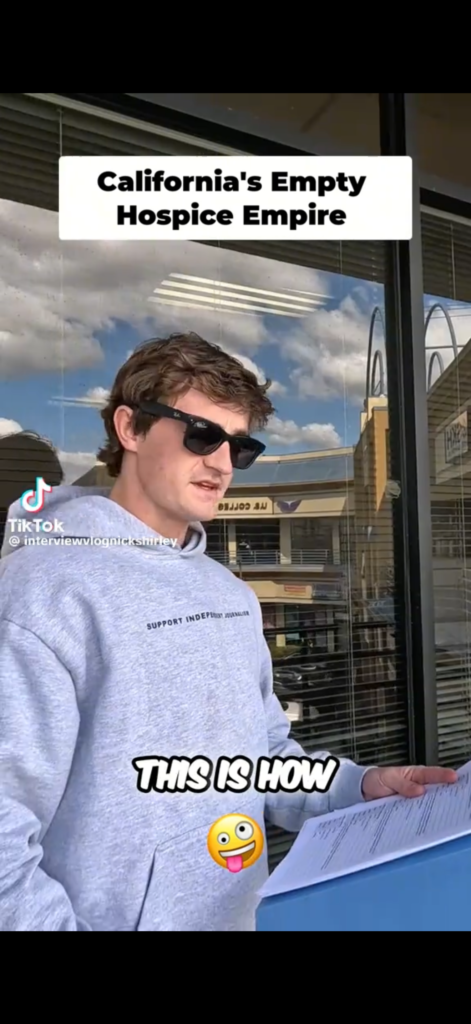
Independent content creator Nick Shirley has once again stirred public attention—this time with a viral video alleging irregularities in the hospice and home healthcare sector in Los Angeles.
In the footage, Shirley walks through multiple commercial locations that are registered as hospice or home healthcare providers. What he finds is striking: empty offices, minimal signage, and no visible staff. Some buildings appear dilapidated, yet house multiple healthcare-related entities under the same roof.
“These places are popping up everywhere,” Shirley says in the video. “No one’s even trying to hide it.”
The claims are serious. The implication? That taxpayer-funded healthcare programs—primarily Medicare—may be vulnerable to exploitation.
But how much of this is substantiated concern, and how much is viral sensationalism?
What the Video Shows
In the now widely shared clip, Shirley documents several businesses with names like “Hospice Care Inc.” and “Home Health Services,” many of which appear inactive from the outside. He points out:
- Offices with no staff present
- Multiple healthcare businesses registered at a single address
- Minimal infrastructure or branding
- High-end vehicles parked nearby
He questions how these businesses operate and whether they are legitimately providing care—or simply collecting government reimbursements.
The tone is investigative, but also incredulous. The conclusion is left open-ended, yet the message is clear: something doesn’t look right.
A Growing Industry With Real Money
To understand the context, it’s important to look at the broader hospice and home healthcare industry.
Hospice care in the United States is largely funded through Medicare, which covers end-of-life care for eligible patients. Home health services are also frequently reimbursed through Medicare and Medicaid.
This creates a powerful incentive structure:
- High demand due to an aging population
- Predictable reimbursement models
- Relatively low overhead compared to hospitals
According to industry data, hospice care has grown significantly over the past decade, particularly in large states like California and Texas.
With growth, however, comes risk.
Documented Cases of Hospice Fraud
While Shirley’s video does not present direct evidence of fraud, federal authorities have previously identified schemes within the industry.
The U.S. Department of Justice has prosecuted cases involving:
- Billing for patients who were not terminally ill
- Enrolling patients without proper consent
- Paying illegal kickbacks for referrals
- Creating shell companies to submit fraudulent claims
In several high-profile investigations, networks of hospice providers were found to be exploiting Medicare billing systems, particularly in urban areas with dense populations.
These cases confirm that fraud is not hypothetical—it exists. However, they also represent a fraction of the overall industry.
Why Empty Offices Aren’t Always Suspicious
One of the most compelling visuals in Shirley’s video is the apparent emptiness of the facilities he visits. But industry experts caution against drawing conclusions based solely on this.
Hospice and home healthcare services are fundamentally different from traditional clinics:
- Care is delivered in patients’ homes, not in offices
- Nurses and aides spend most of their time in the field
- Offices are often used only for administrative functions
As a result, it is not uncommon for these locations to appear quiet—or even vacant—during business hours.
Still, the presence of multiple companies in a single building, combined with minimal operational visibility, can raise legitimate questions.
A Pattern of Grassroots Investigations
This is not Shirley’s first time highlighting potential misuse of public programs.
Months earlier, he gained attention for a separate investigation into adult day care centers allegedly linked to a Somali community in Minnesota. In that case, he documented facilities that appeared inactive despite receiving public funding.
The topic overlaps with the broader controversy surrounding the Feeding Our Future fraud case—one of the largest pandemic-related fraud cases in U.S. history, involving hundreds of millions of dollars in misused funds.
While Shirley’s reporting is informal and not affiliated with traditional media, his videos have contributed to increased public awareness and online debate.
The Line Between Awareness and Oversimplification
The challenge with viral investigations is balancing visibility with accuracy.
Shirley’s video succeeds in drawing attention to a complex issue. It captures a visual pattern that feels inconsistent with expectations of healthcare providers. It raises questions that many viewers may not have considered before.
However, experts caution that:
- Not all empty offices indicate fraud
- Not all clustered businesses are illegitimate
- Not all high-revenue providers are unethical
Healthcare regulation is complex, and while loopholes can exist, there are also licensing requirements, audits, and compliance standards that legitimate providers must meet.
How Hospice Providers Are Regulated
To operate legally in the United States, hospice agencies must:
- Obtain state licensure
- Meet federal certification standards
- Employ qualified medical professionals
- Undergo inspections and audits
- Maintain detailed patient records
In theory, these safeguards are designed to prevent abuse. In practice, enforcement can vary, and resource limitations may delay investigations into suspicious activity.
This creates an environment where both legitimate businesses and bad actors can coexist—at least temporarily.
Public Reaction: Skepticism and Concern
Online responses to Shirley’s video have been mixed.
Some viewers express alarm:
- “This is where our tax dollars are going?”
- “How is this even allowed?”
Others offer more measured takes:
- “Hospice doesn’t work like a clinic, that’s why it looks empty.”
- “There are real providers doing important work—don’t generalize.”
The conversation reflects a broader tension between trust in public systems and awareness of their vulnerabilities.
What This Means for Patients and Families
For individuals seeking hospice or home healthcare services, the key takeaway is not panic—but informed decision-making.
Experts recommend:
- Verifying that a provider is Medicare-certified
- Asking for clear explanations of services offered
- Checking reviews and references
- Consulting with physicians or case managers
The presence of fraud in any industry underscores the importance of due diligence, especially in sensitive areas like end-of-life care.
A System Under Pressure
The hospice industry sits at the intersection of healthcare, regulation, and economics.
On one hand:
- Demand is increasing
- Services are essential
- Many providers deliver compassionate, high-quality care
On the other:
- Financial incentives can attract opportunistic actors
- Oversight systems may struggle to keep pace
- Public perception can be shaped by viral content
Shirley’s video does not resolve these tensions—but it brings them into focus.
Final Thoughts
“Nick Shirley exposes hospice scam” is a headline that captures attention—and perhaps that is the point.
Whether the video reveals widespread fraud or simply highlights isolated irregularities, it has succeeded in sparking conversation. It invites viewers to look closer, ask questions, and consider how public systems function behind the scenes.
As with many viral investigations, the truth likely lies somewhere in between:
- There are legitimate concerns worth exploring
- There are complexities that require deeper understanding
- And there is a need for both transparency and nuance
For now, the video stands as a reminder that even in highly regulated industries, vigilance remains essential.
Have you encountered similar situations or have insights into the hospice industry? Share your thoughts as the conversation continues.